


Creating A Culture Of Ownership - One Choice At A Time

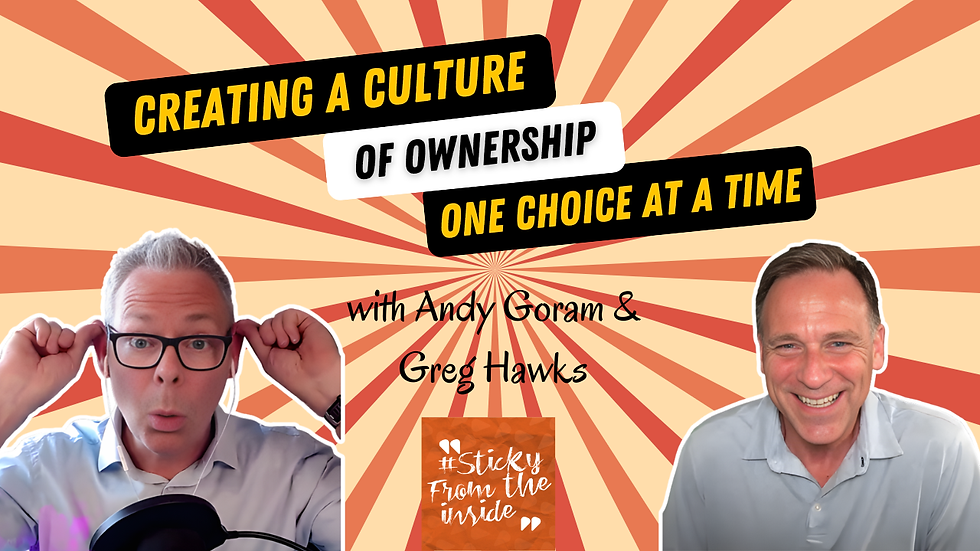
Creating a culture of ownership is one of those ideas that sounds simple, until you try to do it.
Every organisation says they want it. Leaders talk about it constantly. Employees are encouraged, sometimes expected to “step up”, “take responsibility”, and “act like owners”.
And yet, in many workplaces, it never quite lands.
Not because people don’t understand what ownership means. But because, deep down, there’s a bigger question sitting underneath it all:
Why should I?
In the latest episode of Sticky From The Inside, your host, Andy Goram speaks with author of the book "Act Like An Owner", Greg Hawks to unpack this topic.
🎧 Listen to the full episode via the player below:
If you prefer to read, the full transcript is available below this blog.
The Ownership Expectation Gap
There’s a fundamental tension in most organisations. We ask people to think and act like owners, but we don’t always give them the experience of being one.
They don’t make the big decisions.They don’t always see the bigger picture. And at times, they’re on the receiving end of choices they had no part in. So when ownership is positioned as something people owe the organisation, it can feel hollow. Even unfair. And that’s where and why many culture initiatives quietly stall.
What If Ownership Isn’t About the Organisation?
One of the more uncomfortable ideas explored in this episode is that ownership might not be about the organisation at all. It might be about you.
Not in a performative sense. Not in a “work harder” sense. But in a much more personal, practical way. Because when work feels like something that happens to you, your options shrink. Your energy drops. Your thinking narrows. Your experience becomes reactive.
But the moment you shift your mindset, even slightly into:
“How would I show up if I owned this?”
Something changes. Not necessarily externally. But certainly internally. And that internal shift is where ownership actually lives.
Culture Is Not What You Declare—It’s What You Tolerate
This episode faces into another uncomfortable truth.
You don’t create a culture of ownership by encouraging it. You create it by what you allow to exist alongside it.
If people see:
effort go unnoticed
poor behaviour go unchecked
inconsistency in standards
They will check out. Not because they lack motivation. But because they’re reading the environment and seeing what is, or isn't important here. Culture, in that sense, is less about aspiration and more about what really happens in day-to-day behaviour. And one of the clearest signals any organisation sends about that is what happens when things aren’t right. Are they faced into, or ignored?
The Subtle Power of How We Speak to Each Other
There’s a tendency in workplace culture today, to default to positivity. To encourage more, recognise more and celebrate more. And don't get me wrong, those things matter. But there’s a difference between volume, meaning and value.
When feedback becomes generic, it loses meaning.When recognition lacks specificity, it loses impact. And when that happens, something important is lost: credibility.
Ownership doesn’t grow in environments where words feel performative. It grows where people feel seen, understood and valued. And where the espoused values and behaviours are upheld every day.
The Reality We Don’t Talk About Enough
Here’s the part that can get missed in conversations about ownership. We're all constantly making a calculation.
Not necessarily consciously. But we are asking ourselves:
“What do I get from this?”
That might be:
a sense of progress
meaningful relationships
recognition
financial reward
or simply… a better experience of work
When that return is present, we don't just turn up, we invest. When it isn’t, we withdraw. So creating a culture of ownership isn’t just about what people give. It’s about whether the experience is worth giving to. And that is huge!
One Choice at a Time
It’s tempting to think of culture as something that shifts in big moments. A new strategy. A new leader. A new initiative. But in my experience inside organisations and working alongside organisation, that's not how it works.
It shifts in smaller, quieter ways. In how people behave when the going gets tough. When poor behaviour is seen to be dealt with, no matter who that is. And by the consistency in how leaders show up and set the conditions in which we can all thrive.
Ownership lives in those moments as a choice. And when enough people make that choice something starts to change. That's cultural momentum. And it is powerful stuff.
Creating a culture of ownership isn’t about asking more from people. It’s about understanding what makes people want to give more in the first place. And sometimes that starts by looking a little closer at ourselves.
Full Episode Transcript
[Andy Goram] (0:11 - 2:58)
Hello and welcome to Sticky from the Inside, the podcast that explores how to build stickier, competition smashing, consistently successful organisations from the inside out. I'm your host Andy Goram, and I'm on a mission to help you turn the lights on behind the eyes of your people, light the fires within them, and help more of us lead successful, fulfilling work lives. This podcast is for anyone who believes that's worth going after, and who's curious about what really drives people, culture, and performance.
Each episode, we dive into the ideas and conversations that help create what I call stickier businesses, places where people thrive and love to work, and where customers stay, recommend you and love what you do and why you do it. So, if you want to take the tricky out of being sticky, listen on.
Should Employees Really Care Like Owners?
Okay then, let me ask you a question.
Should an employee care as much about the business as the owner? It's a big ask, isn't it? Employees who don't have a stake in the business don't carry the same risks.
They don't always see or are given the bigger picture. And in many cases, they're not even treated like owners would be either. I guess it would be fair to ask why should they, right?
And yet, when you look at organisations that really thrive, where performance is high, culture is strong, and people genuinely care, you often hear a similar sentiment. The people here, they just care, they just take ownership. So, what's the difference?
Why do some people naturally lean in, take responsibility, go the extra mile and think way beyond their role? While others, well, they just do enough to get by or completely disengage altogether. And more importantly, is that really all about them or is it about the environment that's been created around them?
Well, my guest today, Greg Hawks, has spent more than 25 years working with organisations to explore exactly that. He has a very clear perspective on what drives ownership, what gets in the way, and what leaders can do to create environments where people don't just show up, they step up. And he's written the book, Act Like an Owner.
And so, today, we're going to unpack what it really takes to build a culture where people care, contribute, and take responsibility, not because they have to, but because they want to. Greg, welcome to the show, my friend.
Setting the Stage: What Drives Ownership at Work?
[Greg Hawks] (2:59 - 3:16)
Andy, that was the most superb introduction set up, and I've done a lot of podcasts. I want to know about these answers. I want to hear this conversation.
So, it is a pleasure to be here. I can't wait to hear if we discover the answers to those questions or the truth behind them.
[Andy Goram] (3:16 - 3:26)
I'm sure we will. What we have already discovered, my friend, is the energy that you bring to any conversation, right? So, great.
I absolutely love your passion and energy for this topic, my friend.
[Greg Hawks] (3:26 - 3:27)
I appreciate it.
[Andy Goram] (3:27 - 3:42)
We, I reckon, will absolutely get into some of these answers. Before we get into all of that, buddy, just do me a favour. Give my listeners an introduction to Greg, who you are, what you've been working on, and where your focus is today, my friend.
[Greg Hawks] (3:43 - 5:12)
Oh, man. Okay. So, the big picture is I spent a decade as an executive director of a non-profit.
Learned a lot of interesting things there, working with volunteers, serving young people. We did summer camps, thousands of teenagers, transitioned out for the last 15 years, been in the marketplace, took those leadership principles, and kind of moved them into consulting around organizational culture, creating these environments of ownership, and doing a lot of speaking at employee events. The book came out this past year because throughout the last decade, the variations of this message and the understanding of it and getting feedback from people really informed a lot of the things that went in there.
So, now I'm passionate to get the book in the hands of people that don't have to hear me speak, but get that so that there's something they can grab hold of and give some language perspectives. I'm a big believer in verbiage that shapes the way we act and think as it forms our beliefs. Our words are really central to how we think and believe, which then impacts everything else.
And so, that's where right now the focus is in continuing to expand this message around ownership and the language and the thoughts that set people up to be the most fulfilled in life and satisfied at work and productive in what they're doing. And at the end of the day, have great relationships with themself and with others so that they can live out their calling and purpose and have a sense of meaning in what they do.
[Andy Goram] (5:12 - 5:28)
Love it. And that's why I'm excited for this conversation, because you are bang in line with the ethos of this podcast. Just as an aside, everybody, Greg and I had a pre-meet a week or so ago, just a five, 10-minute meet up it was.
45 minutes later, we stopped geeking out on all of this stuff.
[Greg Hawks] (5:28 - 5:32)
Yeah, this is going to be a four-part podcast series, by the way.
[Andy Goram] (5:32 - 6:04)
It was great. It was great fun. And your point about language, I think, is really, really important because there's some, I think the key tenets of your book are really associated with some very clear, understandable language, which I'm sure we will get into.
Because I'm excited, I just want to get in with a big question right at the start. I sort of hinted at it right in the introduction, Greg. This thing about acting like an owner.
I mean, why? Why should an employee care as much about a business as an owner? Why on earth should that happen?
Ownership Isn’t for the Company—It’s for You
[Greg Hawks] (6:05 - 8:09)
Honestly, because it's for their benefit. I have found not in a malicious or selfish way, but people think about themselves primarily first, whether it's a preservation, whether it's a sense of belonging for themselves. And so I want to pitch it as like, listen, this is the best thing you can do for you.
If you will think like an owner, act like an owner, lead like an owner, respond like an owner, you will be the most satisfied you. Because what people have a tendency to experience at work, Andy, is this sense of everything happens to them. Change happens to them.
Decisions are made without them. The consequences of all that they are just responding to. And there's no sense of like, I'm a I'm a part of this process.
It's all being done to me, which to me leaves people feeling powerless, frustrated, disappointed. And I'm not suggesting they can insert themselves and start being a part of the decision making process if they're not at that level, but they can take decisions that were made and instead of being resistant, opposed, they can go, OK, so this is what's happening now. Let's pretend I made this decision.
Whether I like this decision or not, let's just go ahead and pretend I was the one who initiated it. How would I act, think, talk and engage with other people around me? And I promise you, it sounds contrary because people are just like, well, here's my thought.
Well, don't just take your thought. Act and think like an owner and just say, OK, this is what's happening because owners don't have a choice in the marketplace. Owners don't have a choice in the economy.
People have a tendency to think, oh, people in leadership, they've got more. They're also just responding to a lot of things that are happening externally. But they bring a perspective that says, I'm going to, at the end of the day, be responsible for it.
And it shifts the way they engage with the work, with the people and then with the outcomes.
[Andy Goram] (8:10 - 8:52)
I mean, there's so much in there already, but the enthusiasm piece, my friend, I think it's, I think it's fantastic. Maybe it's because I'm British. I can hear the cynics.
Oh yeah. Yeah. Especially about, because a lot of this is linked to engagement and stuff, right.
And then how we communicate, how we involve. And I think you're right. Trying to get away from this being done to mindset.
But I can hear people kind of going, yeah, this is just, this is just an excuse to get more out of me. This is just an excuse to squeeze me dry. Really?
You want me to think I can own it? No, you know, you don't. You just want me to do more stuff for free.
Um, you must encounter that mindset from time to time.
[Greg Hawks] (8:52 - 8:55)
I don't think that's because you're British, Andy. I hear that here in the States as well.
[Andy Goram] (8:56 - 9:00)
As I say, you must come across cynics like that. What do you say to those guys, my friend?
[Greg Hawks] (9:01 - 12:44)
Let me pause that question and expand it on to within Gallup, right? You work with, you know, Gallup's numbers. And they'll say, you know, people don't leave companies.
They leave bosses, right? Like 80% or 70% of people. And people interpret that data to say, we got a lot of bad managers in the world.
And I don't interpret it that way. I hear that and go, we got a lot of people who don't know how to engage with leadership. And so instead of them taking on the challenge of this leader I have is a flawed human being like me, and they maybe don't have any more training than I do, which is annoying and irritating.
But you know what I'm going to do? I'm going to, I'm going to strengthen my communication skills. So I'm the kind of person that can work with any leader that's been placed over me, right?
That shift in perspective then says, you know what this company doesn't, and this boss of mine doesn't get to determine if I get to stay here or not because people leave and then say, well, that's a disruption to their life. That puts their families at risk of income and jobs. And all they're saying is I'm going to go find somewhere else where fingers crossed that flawed human over there has figured out how to do management better.
Now, there are people who are great at leadership and there are people who suck at leadership, no doubt about it, but people justifying, I couldn't stay there because the leader was bad. You're going to find that everywhere. Okay.
So, so, so now going back to your question, why should I take ownership? Because there's so much of our lives we can't control. There's so many people and leaders and businesses and we can't control any of it.
And so I'm not suggesting you go and ensnare yourself to the company and you self-sacrifice. I'm saying if you will just think and you will say, I'm going to show up like I own, I'm going to act like I own the place today, how will I act differently? Because I promise you, Andy, I'm not asking people to do any more.
I'm saying if you'll think this way, you'll act this way. What you'll do is you'll respond to problems differently. You'll respond to your leaders differently.
You'll respond to change differently. You'll, you'll see things through a different lens that currently frustrates you, anger you, cause you to feel very defensive towards things. And if you'll just take on a mindset that says, okay, let's pretend I was the one in charge of all this, even though I'm not, let's say it, when it came down, how would I view this differently?
And I'm telling you, Andy, there are a bunch of people, and I assume there is in the UK as well, that are just not at peace in life. They're just lacking joy in life. They're just living disappointed and they have a tendency to blame everything out here.
I like, if I could, if I could just get this handbook, I could just get this fixed and I could just get this person out of my life and I could just change. I mean, how long you got to be alive before you figure out, I can't do any of that. Like all, most of all of that is out of my control.
What a True Culture of Ownership Actually Feels Like
So how can I take ownership for my life, my leadership, my mentality, my emotions, my responses, and my responsibility. And I bring that to work. Listen, let me just, let me, let me expand your listeners mind.
I'm not suggesting just act like an owner at work. I'm saying act like an owner at home, act like an owner in your community, act like an owner in your own life. So it's not that I'm just saying ensnare yourself to the company.
I'm saying, take this perspective in every aspect of your life and you will find your life, maybe not any easier, but much more satisfying because you retain a sense of, I get to have say in how I navigate forward in whatever situation with whatever person I'm doing it with.
[Andy Goram] (12:45 - 13:15)
Yeah. I mean, you've mentioned satisfaction, you've mentioned fulfillment before. I think this is what lies at the heart of all the engagement work that we try and do, right?
It's, it's, it's often interpreted as I'm ringing you out to get more, more dollar for the boss who's already got loads of dollars when the reality is what we're trying to, yes, then there has to be a commercial benefit for that. And the reality is if the company does well in a good company, we all do well, right? Job security, promotion, benefits, all that kind of stuff.
[Greg Hawks] (13:15 - 14:27)
Can I interrupt for a second? Well, you know what you and I have experienced is when, when I hear people like that and that are frustrated or like, they just want that, I think, I wish you could see these places that have an ownership culture where people do show up, give a hundred percent, have fun in the process, work, make sacrifices, definitely don't have a balance, but are navigating that, but they're so engaged. Like, and it's not for the sake of the company, but it does something in their hearts and minds where the, and you find an environment that I'm sure you've seen that, like, right where the people are like full on and you're like, all of you people that are over here crying and complaining and resisting, if you knew what a place looked like where people do this, you would also say, I want to be a part of that, but you don't get to just be a part of it. You contribute to it being that way.
And so that's when I hear people push back, I think, I just wish you could see this place, these places that I have seen where people do show up like this because it's different than what it doesn't, they don't feel used at all, right. They don't feel taken advantage of at all. And they're thrilled to make sacrifices in an appropriate way in seasons because they really value the whole.
[Andy Goram] (14:27 - 14:48)
Yeah. I think that contribution word is critical in all, in all of this stuff. I also want to pick up on a word that you talked about a couple of minutes ago, cause you mentioned mindset and I know within your book, you specifically look at a handful of mindsets that you think explain a lot of this kind of background stuff.
Do you want to share that stuff with us right now?
Unlock #1: Why Risking Bold Commitments Changes Everything
[Greg Hawks] (14:49 - 17:16)
Sure, sure, sure. Yeah. I call them five unlocks, these things that unlock inside of us, right?
Again, they're for us, but the first unlock is to risk bold commitments. That idea of risk-taking is where return lives, right? Where the, where you get something back, if you just play safe and just, you know, hang tight, you don't get to experience a lot of the fullness of life because life requires risks.
And the idea of bold commitments, people, they want to make commitments, but they don't, they don't, again, it's that idea of like, Hey, I'm going to make a commitment to be this kind of person, regardless of how you are. People want to make commitments that are in line of how other people respond. And that's just not the way like life works best when you continually justify yourself for your own level of commitment based on someone else.
And so in this one, you know, I'll talk about in the book, even how, um, Andy reps, you know, where people show up like the first day on the job. And I think, I think everybody shows up the first day with a mindset of an owner that they show up and they're like, I want to contribute. I want to show that I'm of great worth.
I want to bring value. Like when people get hired, they're like gung ho and like, yes, let's do this. And so they'll start offering things, you know, in a meetings like, Hey, I've been watching, um, some YouTube podcasts.
I've been listening to some audio podcasts. I've been reading some books and here's what I think. And they, they want to contribute.
And everybody that's been there while I was like, Oh dude, simmer down. You know, we're going to crush your soul too. Like we're going to tell you, you know, we're going to take all this zeal and energy and excitement you have and we're going to snuff it right out of you.
And so that's the environment. And so that, and that without contribution, it's hard to have commitment. As you know, you know why you show up to this podcast?
Cause you're the one who created it. You don't go, man, I don't know if I want to go to the podcast. Well, you're contributing because you own this thing and you're highly committed to it.
And so all of those work together to enable you to be consistent, to be, to care and to honestly bring your best every day to it because you've contributed and committed to it. And so risk and bold commitment is to me is the cornerstone. If people aren't capable of making commitments, not based on anything else around them, but just themselves saying, this is the kind of person I'm going to be when I show up at work, then there'll be moved, there'll be constantly moved and won't have a sense of settledness if they haven't done that.
Owners, Renters and Vandals: The Mindsets That Shape Culture
[Andy Goram] (17:16 - 18:00)
Okay. So there's a couple of things going on here. I don't want to derail the stuff on unlocks cause I think that's a really key part, but I do just want to backtrack a sec because you've just, you've just lumped one of these mindset types.
I think when you refer to somebody who turns up as an owner right from the get go, I think if I've done my research correctly, you've got another couple of mindsets that maybe lay out the full scene. So we've got these owner guys who come in with the right attitude, the mindset that's in line with your book, who want to make a contribution, who want to sort of have ownership, who want to really participate in the organization rather than just turn up, but you've got another couple of characters, I guess. Right.
[Greg Hawks] (18:00 - 20:57)
You have done your research, Andy. You showed up today, ready to engage. So I do, and it comes from an investment.
So while I was running the nonprofit, I also started buying single family property homes. I had a handful of those for the last 25 years I've been in real estate investing. So that's where the framework comes from, the owners.
And then the second mindset you're referring to as renters, people who show up and just need the space, they use it for themselves for the season of life they're in. And I've had people who lived in my homes who took better care of it than I did. Right.
So they, they were renters, but they had an ownership mindset. They treated the home great. They planted gardens.
They, I mean, they did all kinds of things because they cared about it. And, um, and that's part of my language with it is, is that, you know, the owners, I say, bring their heart, head and hands, these people who show up, they bring their passion, they bring their care and they bring their skills. Whereas renters, they just bring their hands.
They show up to work every day. They do the job. They do the job well.
And then when the day is over, they clock out and they don't think about it anymore. They don't care. They're not using their imagination.
And. I have found oftentimes they've learned it's just not worth it. Like this place doesn't value that I can show up and just do my skills.
If I show up with passion and care makes no, I don't get any return on that. So I'll just show up that that's why the environment culture. And in the third one, man, it happened like the second year I was in real estate.
I had real estate, the second house I bought, I moved four college boys in and they destroyed the place. They were vandals and they, I'm telling you, they pummeled my home, thousands of dollars of damage, and not a one of them took responsibility, all blamed the others and blame and their parents even came in and were like, not my little angel, you know, and I'm like, well, you might have a devil there, my friend. But, uh, but it was a really interesting, and I just learned how people who can be so destructive and take zero responsibility for the consequences of their actions.
Why Most Organisations Are Fixing the Wrong Problem
And so I, and you know, when you line up with Gallup, Gallup has their engagement where there's engaged and disengaged and then actively disengaged. So for me, it's owners would be engaged. Renters are the disengaged and the actively disengaged are the vandals.
And companies spend so much time in the middle piece on the renters. And it's just a big miss because over 25 years, they've been doing their research as long as I've been, I've owned houses and that, that middle line just doesn't, I mean, it's up a point, it's down a point, it's up a point and it's up another point and then it's down. I mean, it is 50 to 53% the last 25 years with very little change.
But what does change is when the actively disengaged goes down, the engaged goes up. What companies want to do is go the disengaged to be fully engaged. Let's get the renters into owners.
And really what they need to do is deal with the vandals and get the people who are creating toxicity in the cultures. When they remove those ownership goes up, engagement goes up. Disengagement stays about the same.
It's very strange how that, how that happens.
[Andy Goram] (20:58 - 21:34)
I think that's a really interesting point because I'll often talk to groups about going where the sunshine is when we think about engagement, if you're going to get momentum behind a culture initiative or anything, actually you want to engage all those good folk that are up for it, but you need a few of the maybe guys sitting on the fence to help them to drive some momentum. Many people can try and turn around and spend an awful lot of energy trying to turn around the vandals. And, um, that's, that's, that's a really hard gig.
I think the message that people really get though is when the vandals and particularly the vandals, perhaps who might hit their numbers, but they're just asses.
[Greg Hawks] (21:34 - 21:34)
Yeah.
[Andy Goram] (21:35 - 22:29)
It's when they're gone. It's when the, the management leadership says, okay, you hit your stuff, but you're hurting everything else. You go, because that's the message that sort of needs to be sent in an organization, because to your point, that middle group think it doesn't matter because two things are going on.
They're good effort when they've made it isn't recognized. And when someone is kind of like causing problems, well, that isn't tackled either. So what, what, what is the point?
Right. So I'll just stay in the gray and, you know, the recent global workforce Gallup update has just loaded. I mean, we've gone backwards again.
You're like, like for the first time in like three, four years, we've now gone backwards. So this thing has been oscillating in stagnation for goodness knows how long. So we need to do something different.
We need to, to use one of your words. We need to somehow unlock it, my friends. I'm going to bring you back to your unlocks.
[Greg Hawks] (22:29 - 22:30)
All right.
[Andy Goram] (22:30 - 22:33)
Okay. Okay. So we got the bold commitment.
[Greg Hawks] (22:33 - 22:33)
Yeah.
[Andy Goram] (22:34 - 22:36)
Unlock, unlock number one, risky bold commitment, right?
[Greg Hawks] (22:36 - 23:00)
Let me ask you, Andy. So, cause I'm not in the, I'm not in your world. What would that look like for someone who's listening to your podcast or, you know, engaging with us right now, when I say risk bold commitments, how do you translate that in kind of the organizations you've been a part of and the people you have relationship with in the business community you're in, like, how would you go, you know what that means for us here?
[Andy Goram] (23:00 - 23:52)
I think that's putting some stretch and challenge into what we're going after. So it doesn't feel mundane. So it feels like something worth striving for.
A lot about what I talk is about trying to find what drives the business and what drives the people within it. And I think naturally, if we looked at a bell curve of performance versus pressure, if everything's a bit samey and a bit easy, we underperform cause it's too comfy, whereas I think when we make some really strong commitments, there's a little bit about, oh, okay. Okay.
I've got to sit up. I've got to pick my ears back now. I've got, I've got to have a, got to have a go at something, you know?
And I think that's what drives some energy and momentum and some creative thoughts, some innovation, camaraderie, contribution, ideas. And that's the stuff I think that's sort of like simmering underneath a good culture pot, right? When that stuff starts cooking.
[Greg Hawks] (23:52 - 23:58)
So did you use the phrase, prick my ears back? Cause I don't use that phrase. Tell me what that means.
Cause I want to start using it.
[Andy Goram] (23:58 - 24:06)
I'm like, I'm going to use it. Just like a horse, prick my ears out and like, I'll start listening to some stuff. Right.
I can hear more.
[Greg Hawks] (24:06 - 24:10)
Well, I'm going to start filtering out here. I'm picking my ears up.
[Andy Goram] (24:10 - 24:13)
When a horse is interested in something, up come the ears. Right.
[Greg Hawks] (24:13 - 24:14)
I gotcha.
[Andy Goram] (24:14 - 24:18)
I get that. That's my interpretation of your risky bold commitments, right?
[Greg Hawks] (24:18 - 24:44)
Yeah. Yeah. And I think, I think it's right.
It's an interesting cause like the pendulum has swung where there was so much like, let's make it so great for the employees and let's make sure they're all very comfortable, but innately in human nature, there is something about us that wants to be pressed and wants to be challenged. And when we find something that we grab hold of and say, I want to see that accomplished, man, it lights something in us, right? That idea of like, I want that.
[Andy Goram] (24:45 - 25:22)
Yeah. Even if the thought of it scares you coming through it and achieving something boosts you, right? Look, look what we can do.
That can absolutely release some of that latent potential with an organization within the people in it to achieve something you didn't quite think. Paul Zack's work on trust is great in that respect because he talks about inducing challenge stress to really, really build trust between a manager and an employee, just giving them a task that's not crazy, but just a little bit further than they think they can do really sends massive trust signals that no, no, no, you, you, you, you got this. And when they achieve it, there's real belief that comes out of the back of it too.
Unlock #2: Activating Lasting Value Through Words
[Greg Hawks] (25:23 - 25:29)
Yeah. That, and that honestly, that leads right into the, the second, um, unlock is what I call activate lasting value.
[Andy Goram] (25:29 - 25:29)
Great.
[Greg Hawks] (25:29 - 29:59)
And I, and I focus on free words and I'm not sure how this will translate in your world, um, but you know, I, I believe strongly in the power of words, they contain life and you're, you're going to speak things and encourage people. But like my personality, what can happen is I can think I'm an encourager and I'm an expert. I'm like, man, you're awesome.
You're great. You're the best. Thanks for being here.
And I feel like, look at me. I'm an encouraging force, but the truth is those little, what I call sugar hits, they're, they can turn negative pretty quick if I'm going around. I'm telling everybody, yeah, yeah, yeah, yeah, yeah.
You're the man, you're the woman, you're the girl. You're the, it's like, oh dude, whatever. Like I, I, that guy's not producing anything.
You just told him he was great. You know? So there's a lot of like the shallow.
And so for me to activate lasting value, I like, I'd look at the words and think, how can we be thoughtful and I call it strategic, but it really is a consideration of what can I speak to? And the thing you just said, you know, one of them is when I am specific about it, if I said, Andy, you don't have things I love working about you, you show up every day with a positive attitude. When we hit bumps, you always have like a solution mindset to it.
And when, you know, we, when we're working with clients, you just seem to always have a regard and respect that you're open to their feedback and you also kind of stand your ground. And so I really appreciate the demeanor you bring to work every day. You know, when I say something like that, then it's specific and specificity is what makes all the difference in our words, making an impact in people's life.
And so this activate lasting value, it is an interesting that it happens because it's a, it has a reciprocity to it. So if I say to you, Andy, man, I just like you like just sincerely, no manipulate, nothing, just like Jane. I go, man, I just like you.
There is something that happens inside of you. Even if you don't want it to, you'll be like, I think I like you too, Greg. I don't know if I want to, I don't know, but it has this reciprocity that then speaks right to the thing you spoke about, because it's not so much that we need to like each other.
It's that if we're going to have trust in our relationship, there has to be a foundation of likability. People don't trust people they don't like. And so this idea of people like people who like them, that's to me, that's the, it's one of my favourite points in the whole book.
It's like, if you can just take on an attitude that you like the people you lead and you will say, you don't have to be a likable person, they don't have to like you off the bat, but if you say, I like these people. And Andy, a lot of people shoot themselves in the foot cause they're, they'll just start bad about the people that are leading and that's, and that's a real leadership miss because once you go, I like you or I like you, then what happens is you start finding things you do like about them. When you start from that position, you will find things more in common.
Most people think I'm going to wait and see if I like you or not. I'm going to learn about you. I've spent time with you.
You know, these are the things I don't like about you, right? Differences create distance. And as a leader, we're always trying to that trust gap.
How do we bring people close to us and how do we get close to them in a professional way that causes them to know the heart and mind, right? The ownership qualities. And it, and it causes that.
The final thing I'll say on this is like, our souls are leaky. Unfortunately, like the negative sticks and the positive slips. That's, that's my little phrase.
So somebody could have said something to you ugly 10 years ago, and you still remember it, do there are people 20 years ago that are lives have been shaped by some negative words, somebody close to them said, and yet six months ago, somebody said something really positive to them and really significant. Makes no difference in their life right now. And so that specificity puts hooks in the soul.
And then it causes you to go. Not, Hey, I like when Greg says these nice things about me. It said you, it causes you to think I like being this kind of person.
I'm so glad he recognized this because I like to see myself this way. I like to think of myself this way. And so it creates that internal motivation where real motivation comes from and it gives people words to believe in themselves about, and that's the greatest gift of leadership when you get to say, I see this in you and they go, really?
Okay. I'm going to live into that. And not just because I don't want you to just pat me on the back.
I want to be that person. So I, you know, I've had that, I'm sure you've had that where somebody believed in you or said something to you that caused you to go, I want to be that person. They see me more than I see myself.
I want to. And so that's what that activate lasting value, because then what it does is it shifts my life. Changed when different people spoke into the potential that I had and I acted on it.
It created a lasting value in me and caused me to be more valuable to others.
[Andy Goram] (29:59 - 30:34)
I love it. Um, and I've spoken about my own experiences about that sort of stuff and people who've influenced me, but there's nothing like having someone who believes in you more than you believe in yourself when it comes across as genuine. Right.
That that's an empowering thing. And I think your point about liking, I mean. You know, Robert Gialdini's work on influence and persuasion says all of those sorts of things.
I think the thing that I pick up from what you're saying is someone's going to take the first step in this relationship and it might as well be the leader, it needs to be the leader. It needs to say, it's okay. It's okay to say, you know, it's okay to say I like you.
Um, that's, that's what happens here. Okay. My friend.
[Greg Hawks] (30:34 - 31:07)
Cool. Like if you change your own mindset and go, I'm going to start talking to my boss, like I'm the boss. Like I wish the boss talked to me.
I'm going to take on that. And you act like that owner. Then it removes a lot of angst and frustration and disappointment.
And there are people going to work just very disappointed and frustrated with people and they just blame the leaders should go first. And if they don't, then you can act like an owner too. And you can start saying things and you can start leading up like that.
And you can start behaving like a person who's taking responsibility for their own life.
[Andy Goram] (31:08 - 31:20)
Yeah, absolutely. We must remember that perspective. Like that, that's, it's a two way street here.
Totally agree. And this is about giving employees agency, right? This is about helping employees feel more connected to what's actually going on.
[Greg Hawks] (31:20 - 32:27)
And Andy, there are generally some companies who don't want people to have agency and autonomy. They just, they're like, we want renters show up, do what we can tell you, get the job done, go. And so, so it's not like I'm not, I'm not trying to live in some.
Imaginary world. There, there are places that I know don't want this and I get it. They're just like, we got tasks.
We like to be taskmasters and we just want you to do the job. And so I'm, I'm not suggesting that those places don't exist or that when you're in them, that you can't find that, but I have found even in those kinds of environments, if you yourself think I'm going to just act like an owner, even in the, just in your own cube world or your own section of two or three people, you're like, I'm going to find my own agency in this place. Even if it's restricted, I'm going to find ways that I'm going to show up because me to go, I got integrity in this, I'm bringing my best daily, despite all the resistance.
I just find in life, Andy, you live like that in the midst of it. It may feel drudgery for a season, but there's always a return on that.
[Andy Goram] (32:27 - 32:30)
Totally agree with that. Okay. I know there's a few more.
From Mindset to Behaviour: Ownership, Trust and Personal Return
[Greg Hawks] (32:31 - 32:39)
There's a few more. There's three more reach for responsibility, widen the circle and think whole house are the three. And the last one, let me just tell you the story.
It's the last one.
[Andy Goram] (32:40 - 32:41)
That's the most important. I think, right?
[Greg Hawks] (32:41 - 38:05)
It really is because that most people, this is where, so when I speak about this, I share a story I had here in the States, there's a sorority alpha gamma Delta, and I had a four bedroom home, three bedrooms upstairs, one bedroom downstairs, and I moved five alpha gamma Delta girls from the university of central Oklahoma into the house. Three of them got thrown upstairs. Two of them shared the primary bedroom downstairs.
And I was like, this is incredible. Cause their moms or dads are paying for it. You know?
And it's like, I'm like, I'll put an AGD West on the garage. We'll just, cause he's like sophomores, juniors, seniors. I was like, I'll keep rolling out for gamma Delta girls in this home for decades.
You know, what happened was the girl upstairs in the middle, she pinkified her room. It was like pink exploded in their walls, sheets cut. Everything is pink.
You walked in, you're like, Whoa, this is Pepto bismal. Like this is seriously pink. And also she had like built a shrine to her boyfriend.
This was back when they did collages and like literally like poster boards. And so you walked in, you're like, I sensed the presence of your boyfriend in this room. Like it was like, Holy space.
So she loved her room, right? She cussed, she lived there every day. She thought my room is the most important room.
Matter of fact, she spent a lot of her time there. And so downstairs, the ladies who shared the primary bedroom, not once, but twice took an iron and put an iron on my carpet. There were two different iron burns on my carpet in the primary bedroom.
They didn't, they were doing something for their sorority world, doing it. And they let it fall and it burned it. And so I say, do you know what the gal upstairs in the pink room thought about the iron marks on the carpet on the primary bedroom?
Not a thing. It's not her room. She doesn't care at all what happens in that room.
And that's exactly how renters think, right? Because they think their room's the most important and I'm sure where people work and live because that's where they spend all their time and that's where their education is, that's where experience is, that's where we, that's where we're paying them to contribute. But this idea of an ownership mindset as the owner of the house, you know, I'm like, I like the upstairs bathroom.
I like the downstairs kitchen. I like the laundry room because none of these rooms have value, except that they're part of the house. The challenge people have is they're like, people don't know what we do around here.
They mean, people don't appreciate all the things we do to keep this place going and moving and, and have all that. But it's like your room is valuable, but it's valuable because it's part of the house, not the house is valuable because of your room, because your room outside of this house is just a box in the field. Your department that's so valuable.
It only has value in context. And so as someone who has an ownership mindset, at least you can go, listen, I appreciate the role I play, the skills I bring. I know the value of my room, but I value the whole.
And this shows up typically Andy, when other rooms are having challenges or if the rooms are succeeding and our attitude and perspective towards those rooms, we go, man, those guys are always a drain or it's like this friction between two different departments because they just can't figure out. We're on the same team, man. We're working towards the same goal.
We're serving the same clients, products, service lines, and yet they just get so frustrated. And what I have found, and it's a Lencioni principle that, you know, you, if you go up and you track or you find a leader who thinks their room is more important than the house from that person down, there'll be fractions and factions and division and frustration because they, their perspective, it feels like it's semantics, but it's not valuing the whole chain. When you go to your executive leader and you're like, I'm here for the house.
And then I serve the room. Or if you're, Hey, I'm coming as an ambassador for my room. And I'm coming to this meeting to fight and make sure our room gets everything.
It's not semantics. It changes the dynamics of how people communicate, act, respond, and create value in the areas in the rooms that they have responsibility for. So that's a, it's a really worthwhile.
Cause it's all heart and mind, right? It's like you, you can't have a skill for every one of these rooms. We're not asking you to work in every one of these rooms.
We're asking you to care and think about, I'll joke about it. Hey, have you ever had like an HR person come to the sales team and say, Hey, we've been talking in our HR department about how sales could function a little better around here, right? And the sales team erupts in laughter and they're like, that's cute.
That's cute. Who are you? Have you ever sold anything in your life?
Do you know anything in sales? Like, go, please go away. Please kindly go away.
And there's this idea of like, because your skills are in this and we're here. So they differentiate. On renter abilities, not care or passion or imagination.
And they don't know that in the HR, they've been doing exit interviews with people from this sales team and they've been learning things and hearing the same thing. And they're like, we care about the whole. And so we want to come over and see how we can make this room better.
But there's such a. Rejection because it's a different room and there's not an appreciation that the heart and mind are as valuable, if not more valuable than just the hands, your experience and your education and your knowledge. And so, I mean, it is it, but then, you know, what if a salesperson came to HR and said, Hey, we've been talking to our sales team about how HR, and they're like, have you ever written a policy?
Do you even know about it? Right. So there's that.
It goes both ways. And so this idea of how do we create an environment where there's this invitation that says, let's, let's cross pollinate. Let's make sure we're keeping the doors and the information going both ways and be really thoughtful and intentional about it.
So the house succeeds.
[Andy Goram] (38:06 - 38:42)
Yeah. I'm, I'm working with an organization right now who just dipping their toe into this, and it's on the back of a very, very strong foundation of trust. A lot of work been put in to understand each other, trust each other.
And now beginning to invite, let's use the word ideas or critique on things they're seeing in other departments. And it's okay. It's okay.
It's still a little frosty. Right. At the starting point, even with all that kind of great trust and the enthusiasm and the psychological safety associated with it, it's going to take some time, but it's great that they're sort of leaning into some of that stuff.
[Greg Hawks] (38:43 - 39:27)
It's interesting. And he's like, you and I, we go in from the outside and everybody, every department, all ears listening, they're like, they've got no, and yet somebody from the inside that, you know, I've had this experience and you probably have it too, they're like, I've been saying that for the last two years. And this guy comes in from nowhere, doesn't know anything about us, makes his observations, does this and assesses and goes, Hey, here's what you need to be doing.
And they're like, oh, okay, we'll do that. And then, you know, somebody's in the back room like, what the heck? I literally have been because there's something about that dynamic that, and then once you, once you achieve that, the value just exponentially increases.
Cause when people do care, they're really are thoughtful about how the whole can be better.
Designing the Conditions for a Culture of Ownership
[Andy Goram] (39:27 - 40:00)
Absolutely. I totally, totally agree with that. Totally agree with that.
So look, we've talked about three different mindsets. You've highlighted around five unlocks. And I think the thing that you've definitely started to talk about, and again, using your words, the environment, right?
The conditions to be able to act like an owner. I like, if I can, for my guests to make things as practical as possible for the listeners. I think you've got like a design framework, right?
You've got a framework for creating those conditions of ownership.
[Greg Hawks] (40:01 - 42:56)
Yeah, let me, let me just preface it with this. Cause even though you're, you're talking about it, so let's put the onus on leadership now. I've been trying to put it on your listeners right now, but let's put on leadership, creating this culture and creating this space in this environment.
What's critical is they know what the return on investment is for an individual. What is it that motivates people? And so, you know, I have this thing called the E frog, which is emotional, financial, relational opportunity or growth.
There are people like us, Andy, we, we find as much return and a willingness to sacrifice if we're going to grow. Like, if we're like, you know what? This is going to stretch a new muscle.
This is going to challenge me in a way this is going to deposit some wisdom. It's going to give an experience, right? Some people, they're like, give me money.
I need money. And, you know, we're like, give me an opportunity to grow in a way I've never grown and I, you don't have to pay me a whole lot because I'm getting a different kind of return. I mean, I like to be paid.
No, you know, like everybody, I mean, baseline pay, but that idea of what motivates people that's on leaders to understand, because if we're going to ask people to step up in ways that feel bigger than renting, then I'm an investor. I didn't buy these houses just for fun. I put a big investment in because I expect something back.
I expect a long-term return and I expect some short-term gains as well. And everybody who shows up to work, the CEO, the exec, they're all getting a return that they value and they're all acting like owners because they're getting a return from it that they've said, this is important to me. So in the 3D model of really like discovering values, and again, Lencioni is a big influence on my life and those kinds of things.
You know, it's just like this, this is who we are. This is what we actually care about. We can't make these up.
You discover them. And then you define the culture. This is the kind of people who will thrive in this place and who will work here.
And then you describe the behaviours. And I feel like people miss this part to say, this, this is what we value. This is what the place needs to be like.
Here's what it actually looks like. Here are the, here are the traits of each of these values. And here are the anti-trades, you know, I've got a lot of great little sheets that people have put in their offices and like, here's this value of innovation.
So our values of innovation, here's what all that looks like. Here's what it doesn't look like, right? Here's our value of unity.
Here's what it looks like. Here's what it doesn't look like. And so I find that so that, that of just discovering your values, because they already exist there, defining the culture, here's who and how are going to fit in this kind of place we want and describing the behaviours, here's what these behaviours look like, here's what they don't look like, set you up and you can do this within a team, if you're a multi, you know, national corporation and you're like, this is our department, this is our location, this is our team, this is our floor, this is our office.
You can do it with five people, you can do it with 500 people, you know, and the more aligned it is, the more fruitful it is. And so that's what people can do that in their own space.
[Andy Goram] (42:57 - 43:26)
Describing the behaviours, uh, in that kind of positive and negative perspective also sends a sign, right. As to what is not tolerated and come back to that kind of like Vandal area. You know, when we see these behaviours, we're going to really pull them out.
This is not acceptable and we will deal with that sort of stuff. I think that's, I don't want to dwell on the negative stuff because, but that can be a positive because the outcome of dealing with that stuff sends, you know, positive ripples through an organization.
[Greg Hawks] (43:27 - 44:08)
Yeah. And it, and it creates a real clarity because then it gives everybody there at any level of the organization to say, I thought this was not acceptable. You know, it lets people then have a perspective that isn't just random or it's just not unique.
It's like, this says what we will and won't accept. I mean, I'm sure you've had organizations that will do their engagement survey and not, not share the results. The worst possible thing you can do.
And people do it all the time. And I'm like, just don't take it if you're not, because once the results are shared, then people are like, then it gives everybody an opportunity to interpret the data. And people just resist that.
And it's like, you can't, you're not going to create an environment with trust with that kind of approach.
[Andy Goram] (44:09 - 44:22)
There's a whole other episode on my frustrations with engagement surveys and how people abuse them, right? There's a whole bunch of stuff, my friend. Greg, we could easily talk about this for forever, but I'm going to try.
[Greg Hawks] (44:22 - 44:30)
We should host a conference. We should figure out how to do it. Let's do a virtual or a live conference.
I'll come over there. We'll take a half day. We'll bring people together and we'll do something fun.
Sticky Notes: Three Truths About Ownership and Fulfilment
[Andy Goram] (44:30 - 45:04)
We'll have so much fun. That would be awesome. I have this bit in the show, Greg, I call sticky notes, right?
Which when you and I ramble all over the place, having a great time, it gives us an opportunity to kind of ground ourselves and pull the audience back in trying to I guess, three little pearls of wisdom that you could give us, that we could fit on little sticky notes and stick them around our screen. And in this case, you know, capture the practical advice you have for building a culture of ownership. What would your three little sticky notes be?
[Greg Hawks] (45:05 - 45:33)
The first would be ownership is the best choice I can make for myself. The second is acting like an owner creates the greatest fulfillment in me and those I love. And I know that's a long sticky note.
Um, the third, the third is caring with passion, whether at work and my community, at home, serves me best.
[Andy Goram] (45:35 - 46:03)
I love those. What the audience can only hear, but can't see is that in throughout this whole conversation, right? You've been pulling your spleen out, showing passion, driving energy, and love for this topic.
And then the three sticky notes, I can tell they really, really mean something to you because of the way you've just kind of like completely changed your demeanor in that. And that's great, mate. Thank you so much for sharing those.
[Greg Hawks] (46:03 - 46:05)
Yeah. I want to be in service to the people that are listening.
[Andy Goram] (46:05 - 46:15)
I love it. Love it, mate. Now, listen, if people have enjoyed listening to you and want to find out a bit more about you, get hold of the book and all that sort of stuff, where can they head to my friend?
[Greg Hawks] (46:16 - 46:45)
The best place is my website, greghawks.com. I'm sure that'll be in the notes there. My book is on the website.
It's actlikeanownerbook.com. It's just information. And then Amazon has the book, has Audible, my favourite.
I mean, I did the Audible. I read it myself. So I love the Audible version of the book and then LinkedIn.
I mean, I'm like, this is my professional network and I hang out there and I love connecting. So really LinkedIn, Greg Hawks. If you just look me up, you'll find me.
And then my website, greghawks.com and then Amazon for the book, actlikeanowner.
[Andy Goram] (46:45 - 46:57)
Brilliant. Well, thank you for sharing your thoughts, your insights, your experiences. Goodness knows your passion for the topic.
It's been absolutely wonderful. I very much look forward to seeing you again sometime.
[Greg Hawks] (46:57 - 47:07)
Yeah, yeah, yeah. Listen, I think we should, we should do something virtually. I think we should host our own little thing virtually, the two of us for a morning.
I think that would be a really interesting exhibit.
[Andy Goram] (47:08 - 47:54)
I think that would be great fun, my friend. Thanks for coming on and you take care. You too.
Okay, everyone. That was Greg Hawks. And if you'd like to find out a bit more about him or any of the topics that we've talked about in today's show, please check out the show notes.
So that concludes today's episode. I hope you've enjoyed it, found it interesting and heard something maybe that will help you become a stickier, more successful business from the inside going forward. If you have, please like comment and subscribe.
It really helps. I'm Andy Goram and you've been listening to the sticky from the inside podcast. Until next time.
Thanks for listening.
Andy Goram is the owner of Bizjuicer, an employee engagement and workplace culture consultancy that's on a mission to help people have more fulfilling work lives. He's also the host of the Sticky From The Inside Podcast, which talks to experts on these topics from around the world.


Comments