


Why A Great Workplace Culture Is Built Two People At A Time

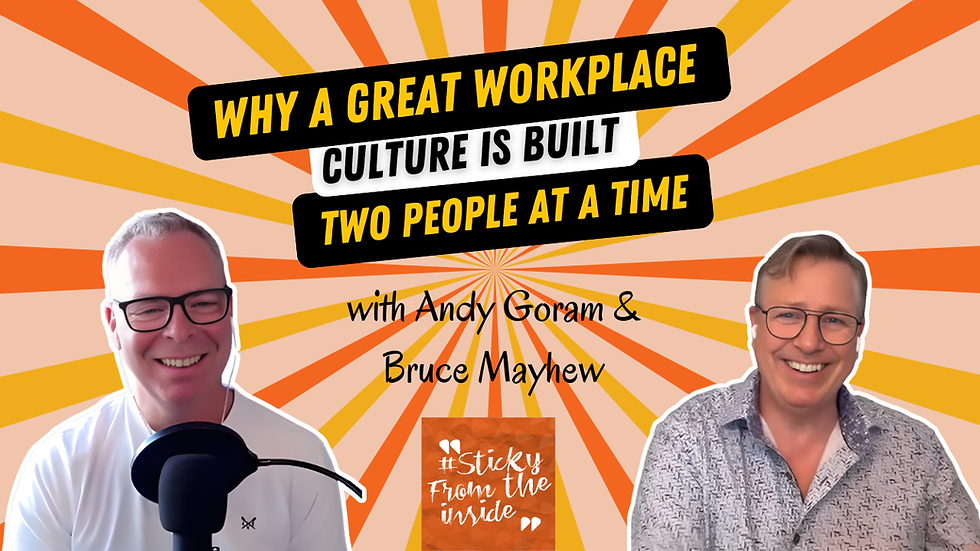
If someone asked you where workplace culture comes from, what would you say? The boardroom? The leadership team? The values on the wall? The employee handbook?
For years, organisations have invested enormous amounts of time and money trying to define, improve and protect their workplace culture. New values are launched. Engagement programmes are introduced. Leaders are encouraged to role model the right behaviours. None of those things are wrong, but the needle hasn't moved for most organisations in decades, despite all that investment. But what if they're not where great culture actually stems from?
Interestingly, one of the very first episodes of Sticky From The Inside explored this idea from a different perspective. My guest, Megan Walker, talked about what she called A Culture of One—the influence a single individual can have on the people around them, regardless of their role or status. That conversation raised an interesting question.
If one person can influence culture, what happens when two people intentionally shape it together?
That question sits at the heart of this conversation with leadership speaker, trainer and author Bruce Mayhew. Bruce believes we've become so focused on organisational culture that we've overlooked where people actually experience it: in the everyday relationships they have with colleagues, managers and teams. He calls these micro-cultures.
Workplace Culture Isn't Experienced Organisation-Wide
Think about the best team you've ever worked in. Now think about the worst. Chances are they may even have existed within the same organisation. Same leadership. Same values. Very different experience. That's because workplace culture rarely feels the same organisation-wide.
It feels local. It exists in the conversations we have. The meetings we attend. The way disagreements are handled. The level of trust we feel with the people sitting beside us. Bruce describes every relationship at work as creating its own micro-culture. Some develop naturally because personalities click. Others require much more intention. But all of them influence how work feels. Perhaps more importantly, they influence how work gets done.
The Story That Changed Everything
Bruce traces this idea back to a colleague called Merike. When he joined a new team, their relationship couldn't have been more uncomfortable. She wasn't rude. She simply wasn't warm. Questions were answered with one-word replies. Conversation was difficult. Like many of us would, Bruce initially assumed the problem was personal. Over time, however, something shifted.
Instead of trying to make Merike like him, he became curious about her strengths. He began asking for her help in areas where she had expertise. Eventually they shared their career ambitions with one another. Only then did Bruce discover something he hadn't understood.
Merike hadn't seen him as a colleague. She'd seen him as a potential threat. Once that fear disappeared, trust began to grow. Eventually they became close friends and one of the strongest working partnerships of Bruce's career.
It's a simple story. But it illustrates something many of us overlook. People rarely arrive at work as blank slates. We arrive carrying experiences, assumptions, disappointments and ambitions that shape how they respond to those around us. Understanding those stories changes everything.
The Real Opposite of Trust
One of the most memorable moments in our conversation came when Bruce challenged something I suspect many of us have never questioned.
He said:
"I believe the opposite of trust is not distrust. I believe the opposite of trust is fear."
It's a wonderfully simple observation.
When people fear being judged, being overlooked, being blamed, losing status, trust struggles to grow. And once fear enters a relationship, it's remarkably easy to start, as Bruce memorably described it,
"painting people with the evil brush."
We begin making assumptions about motives. We interpret neutral behaviour negatively.
We create stories to explain actions we've never actually questioned. The relationship deteriorates before either person has had an honest conversation. If trust is the foundation of culture, perhaps reducing fear is one of the most important jobs any leader has when trying to cultivate one.
Leadership Happens in Small Moments
One of the practical ideas Bruce shared was, as most good ideas tend to be, deceptively simple. He suggests scheduling just ten minutes each week, with every member of your team.
Not to review tasks. Not to chase progress. Simply to ask:
"How are you doing, and what do you need from me?"
It sounds obvious and easy, right? But how often are these conversations sacrificed because we believe we're too busy. Ironically, Bruce argues they're too important not to have. When people know those conversations are protected, they begin to believe something equally important is protected: the relationship. Trust grows through consistency, not one-off grand gestures.
Can Micro-Cultures Build a Great Workplace Culture?
One obvious challenge came to mind during our conversation. If every team creates its own micro-culture, doesn't that risk fragmenting the organisational culture? Bruce's answer was refreshingly balanced. Organisational values still matter. They provide direction and create alignment. But once teams understand those shared values, leaders should encourage them to ask another question:
"What else do we want to be known for?"
That might be exceptional collaboration, outstanding customer care, creativity, generosity, responsiveness. Whatever it is, those additional commitments become the team's own "special sauce." This doesn't replace the intended organisational culture. It strengthes it. Rather than dozens of competing cultures, organisations create dozens of thriving teams pulling in the same direction, but focusing on the relevant, daily behaviours that contribute to the organisation's success.
One Relationship at a Time
Perhaps that's the biggest takeaway from this episode is that great workplace cultures are built through honest conversations. They're built when leaders create space for trust instead of fear. They're built when colleagues become curious instead of judgemental. They're built when people choose understanding over assumption. One relationship, one team, one conversation at a time. Bruce's idea of micro-cultures reminds us that every interaction leaves a mark. The question is whether we're leaving the kind of mark that others will want to build upon.
🎧 You can listen to the full episode here:
📄 Prefer to read instead?The full transcript is available below.
Why a Great Workplace Culture Is Built Two People at a Time - Full Transcript
[Andy Goram] (0:11 - 2:51)
Hello and welcome to Sticky from the Inside, the podcast that explores how to build stickier, competition smashing, consistently successful organisations from the inside out. I'm your host Andy Goram and I'm on a mission to help you turn the lights on behind the eyes of your people, light the fires within them and help more of us lead successful, fulfilling work lives. This podcast is for anyone who believes that's worth going after and is curious about what really drives people, culture and performance.
Each episode we dive into the ideas and conversations that help create what I call stickier businesses, places where people thrive and love to work and where customers stay, recommend you and love what you do and why you do it. So, if you want to take the tricky out of being sticky, listen on. Okay then, now regular listeners might remember that way, way back in one of the very first episodes I spoke with Megan Walker about something she called a culture of one.
The idea that any individual, regardless of role or status, can influence the culture around them. It was a powerful idea. So, if one person can influence culture, what happens when two people intentionally shape it together?
What happens when a team does? And if culture is really built through everyday interactions, are we spending too much time trying to fix culture at an organisational level and not enough time paying attention to where people actually experience it? And my guest today believes, well, maybe we are.
Bruce Mayhew is a leadership speaker, trainer and author of The Path of an Inspired Leader, who argues that culture is built locally through the relationships, habits and interactions that happen between people every day. And he calls these microcultures. Because whether we realise it or not, every team creates its own culture.
And your organisation will have a culture, maybe multiple cultures regardless. And the question is whether we're designing these intentionally or simply allowing them to emerge by default. So, in this conversation, we're going to explore why trust matters more than chemistry, why leaders should focus less on controlling culture and more on creating the conditions for it to thrive, and what practical steps all of us can take to build and scale healthier, higher performing environments.
Bruce, welcome to the show, my friend.
[Bruce Mayhew] (2:52 - 2:54)
Oh, my pleasure to be here. I'm so happy to be here.
[Andy Goram] (2:55 - 3:02)
Yeah. I would love for you just to share a little bit about who you are and what you get up to and where your focus is right now. So, tell us a little bit about you.
Meet Bruce Mayhew and the idea of micro-cultures
[Bruce Mayhew] (3:03 - 4:01)
Sure. As you mentioned, I'm a corporate trainer and keynote speaker and recently an author. I love helping organisations really be their best.
I love helping teams create thriving environments where everybody is happy that they can work through challenges in a really respectful, positive way. I like turning on light bulbs is how I like to put it. I love when teams start sparking with each other and sparking in a good way, I mean, and really learning how to trust each other and collaborate with each other along shared goals.
So, that's what I do now. Early in my career, I used to be with Scotiabank, which is one of Canada's top five banks. And the last, I don't know, six, seven years, I was in the corporate marketing team.
[Andy Goram] (4:02 - 4:27)
Okay. I put it in the intro. I'm interested to sort of understand from your perspective what you mean by microcultures and maybe as part of that, let's get into this belief that culture is perhaps often experienced much more locally than leaders of organisations realise.
So, when you use the words microculture, what are you meaning and what are you seeing in the work that you do?
What is a micro-culture and why does it matter?
[Bruce Mayhew] (4:27 - 8:34)
Sure. It's a great question. There's no one definitive answer to the what is the microculture, because right now you and I are creating a microculture between the two of us.
We're establishing a relationship, a rapport, we're getting a feel for each other, we're getting an idea of whether we think that we could work together, you know, if there's something else that we could do. Do I trust you implicitly? Is it because there's something that's just naturally sparking that is connecting or do I feel like you're standoffish or do you feel I'm standoffish or not authentic?
Authenticity is huge, huge, huge. So, right now you and I are creating one. So, I believe that in some who are looking to a team, a workplace and say that we have a team of five people.
I believe that there's a microculture between each two people. There's somebody that you're naturally going to be drawn to. Their skill set complement your skill set.
Your communication style complements their communication style. And it's a natural compression and we usually embrace those really well. But I also encourage people to look at the other microcultures, the other two people perhaps that you're working with, that maybe there's not the same type of natural attraction about work styles and communication styles.
But you still have, you still are creating a microculture with them. You know, you're still determining whether you can trust them. You're still identifying how you can work with them, right?
How you can take advantage of their skill set, how they can take advantage of yours. So, in a team of five, there are all kinds of individual microcultures or team microcultures going on. But then there is a global microculture around that team as well.
So, it's how does that team hum, right? And I like to use that hum component. It's like, what's the energy in that team, right?
So, is the team positive? Is the team focused on the shared values? So, are there three or four values, values, goals, criteria, brand image, whatever word you want to use.
Are there three or four things that all of you are committed to upholding, right? Regardless of how old you are, or what your background is, or how much experience you have with the organization. Are there a few things that are non-negotiables?
But this is what we stand for. And once we understand what those things are, and we all agree to them, then that creates a microculture. That's our brand image.
That's our brand, right? That's the thing that the other team will implicitly know about us because they'll get that experience over and over and over again. So, that's the thing that we could be known for.
And that's where I like to look at individuals and leaders and say, you do have an opportunity to create a team microculture that is completely reflective of how you want your team to work, right? Or how your team collectively want to work, right? So, even though there might be chaos all around you, you can still create a little bubble.
This is what we're going to be known for, right? This is the fun we're going to have. This is the collaboration that we're going to guarantee on, right?
This is the level of expertise that we're going to put forward, right? So, leaders have that opportunity to do that. And I think that is so powerful.
[Andy Goram] (8:35 - 10:02)
I totally agree with you. I love the bubble thing. I end up calling that, sort your own pond out often when I'm working with groups is like, you create an attractive enough pond in the sea of chaos everywhere else.
People are going to walk past your pond and go, hey, why can't we have a pond like that? And then things kind of start to spiral from there. And I'm sure we will talk about scaling up organizational cultures at some point.
But yeah, that notion of, hey, who are we? What are we known for? What do people experience from us as a team?
And how do I individually contribute to that? I think that's a lovely thing to sort of get started into. I also love the fact that you were talking about the connection element.
Like there are people we're naturally drawn to, and that's our first little microculture. But I love the fact that you said, hey, look at the others. Look at the others, right?
The Merike story: how trust transformed a difficult relationship
Perhaps the ones that I'm not naturally drawn to, or there's maybe something that isn't quite clicking. We can do the corporate thing and ignore that, or we can do the human thing and kind of lean into that. To me, there's a link here because when I first came across you, the information that I got on the topics that you like to talk about was a story about the coldest member of a team, right?
And how that sort of spawned this whole microculture thing. Can you maybe just tell us that story? I loved that story.
[Bruce Mayhew] (10:03 - 13:43)
Yeah, it's a great story. So I moved from corporate sales into the corporate marketing team when I was at Scotia. And when I joined the corporate marketing team, it was a small group.
There was one individual, Merica, and Merica had been there for a while. She'd been with the bank longer than I had been. So she had a lot more experience, a lot more tenure.
And Merica and I didn't get along really well at first. And I honestly was, I was young enough that I couldn't figure out why, right? Because I was like, hey, I'm not a bad guy, right?
I'm okay. So it was puzzling to me at first. And Merica wasn't mean.
She just was, she wasn't warm at all. So I'd ask her a question, I'd get a one word answer. It was really challenging trying to create a rapport with her.
And I didn't know any of the stuff that I know now about how to create teams and how to lead well and how to have difficult conversations. I didn't know any of that. So I was running from just the seat of my pants, as my dad would say.
And I slowly, after a couple months, I started realizing that Merica and I had actually a lot more in common than it looked like we should. And I also realized that there were things that Merica was amazing at that I was not good at. And I, again, completely by accident, I started asking her for help because, and I would position it as, hey, Merica, you're so good at this, can you help me fill in the blank.
And slowly, Merica and I started realizing what each other's opportunities were. I think because it was like 25, 30 years ago, that Merica was a female, she was a woman, that I was the young hotshot that just came over from sales. There was understandably a level of fear.
And what I learned was that Merica had been passed over on a couple of things that, frankly, I don't think she should have been passed over on. So I think it was a natural instinct that she didn't like me, that I was a threat. I was a, here we go again.
And the funny thing was that I had no ambitions to become leader of that team, that department. I just wanted to do some great work. And I had a few other goals that were in mind.
And once Merica and I came to a shared understanding of what each other's goals were, and where we could fit together, all of Merica's barriers came crashing down. And in the end, Merica and I became best friends. We literally became best friends.
We would do things outside of work, socially. She was just so much fun to hang around with. And we really liked each other.
And that was such an example for me, that take a look at the bigger picture and see what else might be going on, and see where you can lean into those things.
What Bruce would tell his younger self about building trust
[Andy Goram] (13:44 - 14:18)
I think that's a story that many listeners will be able to resonate with, being in some of that situation. Or maybe they're sitting next to somebody at work, where that kind of vibe's giving off. If you were to look back now and just whisper in the ear of the young Bruce, the hotshot, at that point, with the basis of all of your experience and knowledge today, what would you be telling yourself that you have learned?
What shortcut would you be giving young Bruce into the importance of trust and collaboration and this idea of the microculture, do you think?
[Bruce Mayhew] (14:19 - 16:00)
Sure. I would say be patient, for sure. Don't try to push it.
Be respectful. Because Merica needed to have her space. That was one thing that was 100% Merica, was that Merica needed to have her space.
And so you can't push somebody into liking you. For anybody that's tried to push somebody into loving them, they know exactly what I mean about that one. So just because you want to become my best friend doesn't mean that I want to become your best friend.
And don't have expectations that they're going to become your best friend either. But really be patient and start recognizing what they're good at. Really start recognizing that and be authentic with any type of admiration or recognition of their talents is one thing that I think is really good.
The other fundamental one is share what your goals are. So like the thing with Merica, Merica needed to know that I wasn't there to overlap her. That I was there to simply do great work and to get as much experience as I possibly could.
And once Merica understood what my goals were, I could then listen to what her goals were. She was open enough to share with me what her ambition was. And then we could start supporting each other.
And that was very cool.
[Andy Goram] (16:00 - 16:13)
Yeah. And like you're saying now, two people that perhaps were rubbing up each other the wrong way. And now, you know, they were best friends, great work, high performance between the two of you.
And I suspect that spawned some great stuff.
[Bruce Mayhew] (16:14 - 16:18)
Yeah, we did some, yeah, we had some, we did some really good work together.
Trust before chemistry: why fear is the real barrier
[Andy Goram] (16:19 - 16:48)
Yeah. And maybe this is what links into the idea that you've talked about in some of your work, that trust comes before chemistry. This thing about also forcing people to like you or to love you.
Just explain a little bit what you mean by that. Because seemingly you had two people here who on the very face of it initially just didn't get on and maybe didn't perform together and yet something else changed. And there must be this kind of trust and chemistry thing going on within that relationship.
[Bruce Mayhew] (16:49 - 18:40)
Absolutely. Absolutely. Yeah.
You know, staying with America's example, that's exactly the point is that America and I, our chemistry wasn't good at the beginning. But I had to learn that she wasn't evil. And honestly, that is one of our natural tendencies is when we start getting a rejection or something from somebody, we paint them with the evil brush.
And we really need to let go of that. And that evil brush comes from chemistry. So we really had to look at what we could depend on each other for and what we could rely on each other for.
And that trust is what really brought us the bigger picture. And going back to the values of the team, the values of the microculture, that could be the catalyst. If you're a leader out there wondering how do I get my team to trust each other, go back to your shared values.
And get commitment on those components. Because that's the thing that can align all of you. Whether you're 65 or 55 or 25, whether you have a natural chemistry or not, you can begin trusting each other to deliver on those values.
And once you start building on that trust, then you can start seeing each other as three-dimensional beings as opposed to adversary, adversary, helpful, non-help, right? Instead of character, right? And you can start building your culture that way.
[Andy Goram] (18:40 - 18:53)
Do you think the, I mean, first of all, I love the phrase of painting them with the evil brush. I mean, that's something I think that will live with me for a little bit. Is that a fear thing, do you think, in the main?
Or is that a whole bunch of stuff going on there?
[Bruce Mayhew] (18:54 - 19:49)
Yeah, there could be a whole bunch of things, but I think fear is a strong component of that. Like, I believe that the opposite of trust is not distrust. I believe the opposite of trust is fear.
Yeah. And as soon as I stop being scared of sharing with you or how you might take advantage of me, or if I have to protect myself, that's a fear-based response. And as soon as I stop fearing you, either as somebody who's gonna jump over me or someone that's gonna throw me under the bus, right?
As soon as I stop fearing you, that's when I can start trusting you.
[Andy Goram] (19:50 - 20:20)
Yeah. I'm sure you covered some of these things in your book, which I'm sure will weave through some of these topics that we're starting to get under the skin of. But when we think about breaking down those fear barriers, moving towards a more trusting relationship, from the work you've done and your own experiences, what are some of the practical steps that you have taken or you would advise people to take to help strengthen and build that trusting relationship?
The simple leadership habit that strengthens trust every week
[Bruce Mayhew] (20:22 - 24:34)
Talk with each other. Honestly, as silly as that sounds, start having conversations with each other. So I've already shared the go to your values, right?
So use those as the catalyst that is going to connect you and I. So that is a big component that I strongly recommend. The other thing that I strongly recommend with leaders, and we can do this between co-workers as well, is start having one-on-one conversations with each of your team.
And use that time really meaningfully, right? So and what I recommend, especially to leaders, so it'd be a slightly different variation for co-workers, but for leaders, I would say, so we're going to have a 10-minute conversation, maybe 15, once a week, every Tuesday at 9am. And that becomes a commitment between you and I.
So it's not, hey, if I'm not busy, or something came up or whatever. I can plant foundation on this one, that that is a commitment. And that locked-in commitment, immediately, just the commitment sets a, I'm important.
You're not going to break this meeting because our relationship is important. And then that 10 or 15-minute meeting isn't you telling me what the priorities of the week are. It's you saying, hey, Bruce, what's going on?
What do you need from me? And as you and I get good at this, you'll learn that you expect, hey, you know, Andy, I'm looking for my career, my promotion, what is my next step? So what do I need from you this week might be, what are the skill sets that I need to add to my existing portfolio?
And how can you help me get those skill sets? You know, whether it's special projects, whether it's training, whether it's coaching and mentoring, whatever it might be. Another week, it might be me saying, you know, we're working on this project with the ABC team, and I'm running into some resistance on this point of the project.
And I don't understand why. Andy, can you share some light strategically, organizationally on why I'm getting resistance here, and perhaps help me overcome that resistance. So those meetings are all about me sharing with you.
As soon as I, on a regular basis, start sharing with you, two really good things happen. I start trusting you in a very different way, right? Because now it's not you filling me up, it's me filling you up, right?
So the more I feel you know me, and that you're listening to me, the respect that I get, that's going to create a level of trust that's really cool, right? The other component that I find is really amazing is that Andy, you're going to learn things about me, both personally and professionally, that are going help you be a better leader to me. And that means that you're going to perhaps be able to see an opportunity that I'm not seeing.
So you're going to be able to come to me and say, like three weeks from now, and say, hey Bruce, there's a special project over here that I thought you might be interested in, that would be completely online for you. What do you think? Are you interested?
Or like something along those lines. So you're going to be able to start coming to me in a very different way and talking to me in a very different way that resonates directly to my goals, my values, my culture, my personality, all of those components.
[Andy Goram] (24:35 - 25:53)
I think this is what's so powerful about the 10 to 15 minute personal connection chat, which there are many times I think in the work that I do, maybe you get this same feeling, or maybe you've got less imposters than I do, but I feel like a bit of a fraud saying these things because they, they sound so simple and simplistic and common sense. But the number of times these things get missed or forgotten, because as much as this sort of approach will absolutely build a relationship and build trust and elicit great performance, 100% it will. It's the 10 to 15 minute perverse look at, it's only 10 to 15 minutes.
I'll sack that meeting off because I'm very, very busy. Does the exact opposite totally erodes and undermines all the trust that you've built up? Because you might think, oh, it's just 10 minutes.
I'm canceling that meeting because I've got a lot to do. Well, it's nothing to do with the meeting. It's to do with the relationship.
You're not as important for 10 minutes as something else is important. And that's desperately undermining fraud as well. Absolutely.
And I think this is what we, the traps we fall into, right?
[Bruce Mayhew] (25:53 - 27:01)
Yeah, absolutely. Like that meeting for me needs to be held with really high regard. And the other thing that I like to suggest to, especially to leaders who are doing this, is that they have to set the precedent for the employee and put the employee into the leadership position.
Right? So the employee needs to come with the agenda. Right?
And let's just say it's a nine minute meeting, or a 10 minute meeting, sorry. If the employee comes a minute late, it now turns into a nine minute meeting. Right?
If the employee comes five minutes late, it's now a five minute meeting. It's not like, hey, no problem, we'll extend it. No, no, this is the commitment.
Right? And it's not a walk to Starbucks. It's not, you know, it's not a walk to something else.
It's wherever you agree to do it, whether it's a conference room or somebody's office, that's where the meeting is held. And it's the employee's responsibility to come with agenda and to be on time.
[Andy Goram] (27:02 - 27:45)
See, I love that premise. I think having some skin in the game on both sides is really important. In a very strong sense for me, it links directly to servant leadership, which I think some people will question.
Because for me, the whole Greenleaf proposition of the people I lead grow because of my behavior, my leadership, I think it's instilling those sorts of values and behaviors and importance to that conversation. It's exactly about helping people understand relationships and trust and performance. Because I think the three all kind of come together.
Right? So the saying, well, you're a bit late. So the meeting's shorter or you haven't come prepared for this meeting.
We're not going to do it. That's an important lesson.
[Bruce Mayhew] (27:46 - 27:54)
Yeah. Cause if you cover for them and say, Oh, no problem. I'll talk to you about whatever next meeting next month or next week, they're going to come not prepared again.
[Andy Goram] (27:55 - 28:11)
And we're now talking about culture and it's these tiny little things that erode any culture. You'll be giving approval for this stuff. If you know, people often say the culture you get is the culture you tolerate.
And for me, that comes directly from this behavior, you know?
[Bruce Mayhew] (28:12 - 28:53)
Yeah. Yeah. Yeah.
Yeah. And if you start that, that small and like some people say, Oh, I don't have time for that. But if you start it and you make it part of your regular routine, you do, I can guarantee you, you have time for this and it actually save you time in the back end, right?
It'll save you time down the road. So, yeah, like, honestly, if you have a team of six people, this is one hour of your week where you just bang, bang, bang, bang, bang. You have them back to back and it's done.
Yeah. Right. It's so important.
Can micro-cultures build a great workplace culture?
[Andy Goram] (28:54 - 30:07)
The thing I want to try and talk to you about while I have you with me, Bruce, is the kind of almost paradox of microcultures and organizational culture, because I think you've given, I think you've given the key to scaling an organizational culture in what we've already talked about today. But I just want to make sure we bring it forward because I think it's a really important thing to consider in that knowing the listeners, I can hear people screaming going, it's all the world, fanning the flames of all these microcultures. I need to deliver my organizational culture.
And if I let all this stuff kind of like just breed, I'm going to lose control of this culture. All of a sudden it's not going to be what, be what, be what I need. Whereas I think the key to all of this stuff is being really clear about those organizational values that are held within the organization and then allowing teams to express how they align, deliver, support, extol, maintain those virtues, if you like.
Are we on the same page on that? Do you have the same view, something different? No, absolutely.
[Bruce Mayhew] (30:07 - 32:39)
I think that's the starting ground. The conversation is the organization from on high has decreed that these five values are our organizational values. We have to honor those.
There's no question we have to honor those. So I think it's important that as a team, we now have a conversation about each one of those values and as a team, what each one of those values represent to our deliverables. What is that as our brand promise?
And in our one-on-one meetings, in our 10-minute meetings, you and I this week might have a conversation about one of those values and how that relates to me and my work. So you're now taking organizational values, bringing them into team values, and now bringing them into individual values or individual expectations. But it doesn't mean that we have to stop there.
For me, I think once we do those five values, those five corporate values and have a really clear understanding of how they empower and enable our team, then I think we need to pause and say, okay, team, these are great. What else do we want to be known for? What else can we do that's going to excite us and make us even better?
So is there something because we're the finance team, because we're the development team, what else could we bring to the table? And then add one or two values. And suddenly, I'm getting goosebumps.
I love what I do. But that can make that team proud that they're going above and beyond. They're going to do something special because they are special because they're the finance team.
I think that is where you align all of these orbits. So that the orbits aren't fighting against each other. The orbits are creating momentum and really being amazing.
[Andy Goram] (32:39 - 34:05)
I think there's two things in there that challenge some, I'll use the term incorrectly, conventional wisdom on how you scale culture. But by the way, which I am in full support of Bruce, in that firstly, we're okay with the fact that values have been decreed from on high. Yes, I am okay with that.
Because I think the minute we start having the organization determine the values of the organ, we're almost missing the point that these values have to deliver something. They're not about how everybody feels. They are about actually, what are the core behaviors that we really want to see in this business?
Because we believe they will make us successful and allow people to really deliver inside the organization. So yes, I think they should be formed from a small discreet team. But the stuff I absolutely love is that the teams interpret and deliver those in a way that's relevant to them as a team and to individual.
I think that's really powerful. But also the magic pixie dust here is moving on from saying, what? Corporate values aren't the limit.
We can add our own additional stuff as long as it doesn't pull or detract from where we're all trying to push. Yeah, why wouldn't you? What is your special sauce?
I mean, that's great.
[Bruce Mayhew] (34:06 - 34:20)
Yeah, yeah, absolutely. And it's that special sauce component, right? That's going to make, like how many hamburger joints are there out there, right?
But what's the top, what's the special sauce that your favorite hamburger joint has, right? That's the call.
[Andy Goram] (34:21 - 35:13)
I think this is the thing that I find fascinating about this work is this thing about control and the needs to try and pigeonhole and almost command people to behave a certain way because this thing is really important. No adult I know likes being told how to behave. I just don't think it's, you wouldn't do it in your personal life and have any success.
Why on earth do we think that's going to translate into work life? I have no idea. But I've probably been in teams where, if I'm honest with myself, back in the day, where we've tried to do that and it's failed miserably.
I think this understanding and connection to it and not being scared that, well, hang on, I only want five values. I'm going to have like 150 behaviors. I think if they're all pushing in the right direction, you win, right?
[Bruce Mayhew] (35:13 - 35:20)
You win. Exactly. Yeah.
Yeah. Absolutely. Absolutely.
Yeah. Absolutely. There's no question in my mind that this works.
Lessons from The Path of an Inspired Leader
[Andy Goram] (35:20 - 36:05)
Yeah. So if we're talking to a subsection of the listeners today, Bruce, because I do want to make sure that we reference the part of an inspired leader before this conversation finishes. Now we've talked pretty exclusively about microcultures and trying to scale it up and make it relevant and look under the rocks that you think that might not be relationships there and how to do all those kind of good things today.
But there must be bits in your book about different environments, different situations that leaders are going to find themselves in connected to this sort of stuff. And I just would love to know about where does that collection of thoughts come from for the book? What's inspired that?
And what are you hoping people who pick it up and read it get from it?
[Bruce Mayhew] (36:06 - 39:35)
Sure. That's a great question. And I thank you for that one.
The book is sort of a collection of my experiences over the last 30 years. You know, if you say that. And I really looked back at who are my great bosses?
Who are my great leaders? And I actually looked at who are my awful leaders? Because I honestly now think I had two really bad leaders in my career when I was working.
And I used to resent them, to be honest. Now I am so grateful for them. Because they've showed me what I don't want to be.
And they've showed me, they've encouraged me to how would I work around that in today's world. So the book is a collection of my 30 years. And what I got frustrated with, because I'm a big reader.
I love reading. I love research. I'm almost insatiable about that kind of stuff.
And what I was always frustrated with is that every book was one topic. So I read one book and it's about time management. I read another book and it's about managing change.
And I don't believe that we have time for that nowadays. Sometimes we do. But mostly I think leaders need a little bit of a shortcut into these components.
So about 10 years ago, I got the idea that wouldn't it be really cool to have a book that every chapter was a different scenario that a leader might find themselves in. So it's how do I hire somebody? Because I've never hired anybody before.
How do I do that? Read this chapter and I'll get you 80% of the way and allow you to put your own personality into it. What's the importance of onboarding?
How do I manage a change environment? So something's about to change. How do I prepare my team for change?
How do I inspire people who are different age groups? So every chapter in the book is one of those fundamental situations that a leader might find themselves in. And they don't have to read a whole book.
They just need to read one chapter. And I promise every chapter is 12 pages or less. So that's the goal.
Actually, I lie. I think there's one chapter that's 13 pages. But every chapter you can read in 10 or 15 minutes.
Maximum. And I've given you tools. I've given you processes.
I've given you worksheets that allow you to take 80% of that knowledge and really put your own personality into it. And say, you know what, I'm going to walk into that room with confidence. And then I'm going to listen openly to what other people are saying.
And we'll come up with a solution. So what I really wanted from the book was to create an environment that someone could go to and gain the confidence that they needed in like 10 pages and then be able to walk into a room and know that they're not going to look foolish. That they're going to have a great idea.
That they're going to be able to contribute to a conversation in all of these unknown situations.
[Andy Goram] (39:35 - 40:26)
That's fabulous because I think in today's world, personal development comes in so many flavors. So whether it's a book in the style that you've written it, whether it's a TikTok video that gives you a lesson, whether it's listening to a podcast, whatever it is, I think there are so many opportunities for people to find just those little bits of help. And I think we're both people driven by, you know, if I can help somebody have a better day at work today, then I've won.
Then that's all we're about. So I love the premise of that. And I can see how this links directly to the topics we've kind of given a very, very simple flyby today.
But there's so much richness to this. But the development and getting perspective and learning lessons doesn't have to take eons, right? We can pick up a book, we can read 12 pages and we can have a better idea than we had beforehand, right?
I love that.
[Bruce Mayhew] (40:26 - 40:55)
Absolutely. Yeah. And I, you know, my hope is that you know, people will keep going back to it chapter by chapter.
It's designed so you don't have to read it cover to cover. You could just read it, you know, here's a chapter, right? And then, and I hope people scribble in the margins and highlight it like crazy.
Like that's my goal is that it, you know, in five years, this book looks tired and worn and, you know, that lovely, lovely image.
Bruce's three Sticky Notes for creating healthier workplace cultures
[Andy Goram] (40:55 - 41:25)
Well, we'll put a link to that in the show notes, my friend, no question to that. And before I let you go, we've come to the part of the show I like to call sticky notes, Bruce, where I'm going to ask you for some practical advice. And we're going to focus on intentionally creating these healthy microcultures and the advice needs to be able to sort of fit on three little sticky notes that someone could stick on their screen.
So what three pearls of wisdom, Bruce, would you leave behind in the sticky studio today?
[Bruce Mayhew] (41:25 - 43:51)
Oh, asking me for only three. Oh, my goodness. So I would say number one, be authentic.
Right? Be yourself. Don't try to be me.
Don't try to be that favorite boss that you have. Learn from that boss. See what you can bring into your own personality, but be authentic.
So if you're an extrovert, be an extrovert. If you're an introvert, be an introvert. Be authentic, because as soon as you don't come across as authentic, I lose trust.
I start losing confidence in you. So whatever you do, make it your own. I think celebrate events is an important one.
Celebrating events, whether it's holidays, birthdays, projects that have become success, that you've launched. If you've launched a project, just go, oh, yay. No, throw a pizza party on it.
Or whatever it might be. Celebrate your successes. Celebrate those wins, big or small.
And it allows people to be proud of the work they do. So celebrate and help the people around you, not necessarily under you. So even if it's a coworker, celebrate successes.
And then I think the, I'd like to say, do the one-on-ones. I'd like to say that one. But I'm actually going to shove that one across and say, onboard new people with purpose.
I think we do a terrible job of onboarding. And I think we need to be really, really intentional about when we onboard people around, you know, we're going to be talking about our shared values. I'm going to screw up sometimes.
And I want you to tell me about it. And I expect, because you're new, you're going to screw up sometimes. And I'm going to tell you about it.
But we're never going to do it with blame. We're never going to do it with anger. We're never going to do it with evil.
We're going to be okay. And so I think my third one, I would say onboard.
[Andy Goram] (43:52 - 44:16)
Onboard well. Yeah. I think that's a great opportunity for that psychological contract right from the get-go.
Right. Really, really important. Love those, Bruce.
Thank you very much, my friend. Thank you so much for coming on, Bruce. I've absolutely loved meeting you and love chatting with you.
If people would love to find out a bit more about you, about the work, about the book, where should they go looking, my friend? Where can they find you? Sure.
[Bruce Mayhew] (44:17 - 44:57)
The website is Bruce Mayhew, M-A-Y-H-E-W, brucemayhew.com. And there they will find anything they possibly might want to know about me and the programs that I deliver about the book. They'll see a page dedicated to that.
So brucemayhew.com is a great place. LinkedIn is where I do most of my social work. So I'm posting there all the time about articles that I've written or experiences that I've had and ideas that I have.
So LinkedIn is a really great place. So those two places and we can be really good contacts.
[Andy Goram] (44:58 - 45:06)
Excellent. Well, I'll put all of that information in the show notes, my friend, and people can track you down there. And thank you so much for coming on, Bruce.
It's been superb.
[Bruce Mayhew] (45:07 - 45:10)
It's been my absolute pleasure. I think you and I could talk for days.
[Andy Goram] (45:12 - 46:01)
That is in no doubt at all, my friend. Absolutely no doubt at all. Thanks so much for coming.
Really appreciate it. My pleasure. My pleasure.
Great to meet you. You take care, my friend. Thank you.
Okay, everyone. Well, that was Bruce Mayhew. And if you'd like to find out anything more about the things we've talked about, check out the show notes.
So that concludes today's episode. I hope you've enjoyed it, found it interesting, and heard something maybe that will help you become a stickier, more successful business from the inside going forward. If you have, please like, comment and subscribe.
It really helps. I'm Andy Goram, and you've been listening to the Sticky from the Inside podcast. Until next time, thanks for listening.
Andy Goram is the owner of Bizjuicer, an employee engagement and workplace culture consultancy that's on a mission to help people have more fulfilling work lives. He's also the host of the Sticky From The Inside Podcast, which talks to experts on these topics from around the world.


Comments